

Cart
0
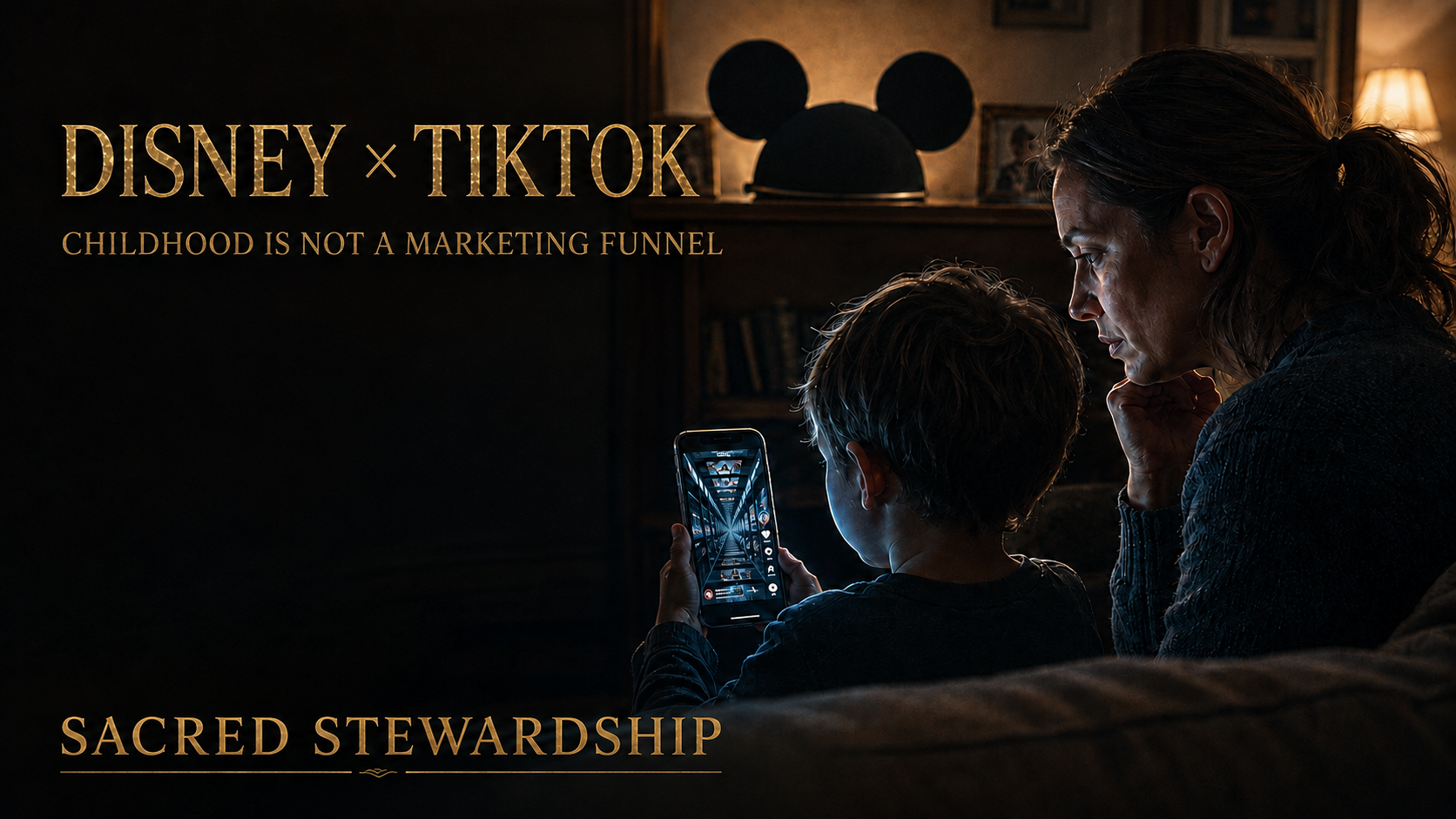
When beloved childhood characters become tools for driving engagement on a platform accused of harming children, families must ask who Disney is truly serving.
Disney’s latest earnings report was celebrated as another victory for one of the most powerful entertainment companies in the world. Revenue increased 7 percent year over year to $25.2 billion, fueled by its films, streaming platforms, theme parks, and cruises.
But beneath the celebration of record revenue and expanding profits was an announcement every parent should examine carefully.
Disney has entered into a global partnership with TikTok that will allow creators to use scenes, characters, and other intellectual property from Disney, Pixar, Marvel, Star Wars, and additional franchises to create short-form videos. Selected TikTok content will also appear inside Disney+ through its new vertical-video feed, Verts. Disney describes the agreement as a way to place “fan creativity front and center” and open doors for the next generation of creators. The Walt Disney Company
This is not simply a partnership between two entertainment companies.It is a deliberate bridge between some of the most beloved characters in childhood and one of the most controversial attention-harvesting platforms in the world.
And we have seen this strategy before.
Last summer, I wrote about the deeply troubling partnership between McDonald’s and Snapchat - another powerful consumer brand using its cultural influence to lead young people toward a social media platform associated with addiction, predatory contact, drug sales, sextortion, and other serious harms.
At the time, I warned that when a trusted, family-oriented brand partners with a platform known to endanger young people, it does more than launch a marketing campaign. It transfers its credibility to that platform. It communicates to parents and children that the digital environment is fun, normal, culturally desirable, and safe enough to enter.
Now Disney is following the same playbook on an even larger scale.
Mickey Mouse. Toy Story. Moana. Pixar. Marvel. Star Wars.
These characters carry enormous emotional power. Children do not experience them merely as intellectual property. They experience them as trusted companions, familiar stories, and symbols of childhood. Disney has spent generations building that trust with families.
Now that trust is being used to funnel attention into the short-form creator economy.
The corporate language surrounding the agreement focuses on “fandom,” “creativity,” “discovery,” and “the next generation of creators.” But behind those appealing words is a familiar commercial objective: reach younger audiences, increase engagement, collect more attention, and move consumers through a larger entertainment and purchasing ecosystem.
Discover a character on TikTok. Watch the movie on Disney+. Buy the merchandise. Play the game. Visit the park. Remain connected to the franchise.
This may be an effective business strategy. That does not make it responsible stewardship.
The timing makes the decision even more disturbing.
A confidential internal TikTok document reportedly revealed that the company withheld a safer version of its recommendation system from approximately 10 percent of its American users - about 15 million people at the time - to measure how the change would affect engagement. The safer system was designed to reduce the risk of users becoming trapped in repetitive streams of harmful content. According to the reporting, the control group included a 16-year-old whose account was repeatedly shown suicide and self-harm material before his death. TikTok has said that it is committed to user safety. Bloomberg Tax
This is the platform Disney has chosen as a strategic partner.
During the same week, a New Mexico court entered a final judgment requiring Meta to pay an additional $567 million to address harms associated with its platforms, bringing its total financial liability in the case to $942 million. The court also imposed reforms involving addictive features, age assurance, privacy, and protections against child sexual exploitation. New Mexico Department of Justice
The message could not be clearer: the digital environment surrounding our children is not merely an entertainment space. It is an enormously powerful behavioral system capable of shaping attention, identity, mental health, relationships, and development.
Yet corporate America continues to respond as though the primary question is how to capture more engagement.
Disney’s partnership with TikTok is especially troubling because Disney has historically marketed itself to parents as a trusted guardian of childhood. Its brand is built upon family, imagination, innocence, and safety.
That trust creates a greater responsibility, not a convenient marketing advantage.
A company cannot claim to protect the magic of childhood while using that magic to draw children deeper into an attention economy that repeatedly places engagement above their well-being. It cannot wrap itself in the language of family while partnering with systems facing serious allegations about addictive design and youth harm.
This is precisely why Sacred Stewardship insists that the crisis facing our children is not solely technological, psychological, political, or legal.
It is a crisis of identity formation and a crisis of moral clarity.
Technology is not inherently good or evil. Its moral character is revealed through the purposes it serves, the values embedded in its design, the people it protects, and the behavior it rewards.
Does it honor human dignity or exploit human weakness?
Does it strengthen families or undermine their authority?
Does it serve human flourishing or demand human submission?
Does it protect innocence or monetize access to it?
These are not secondary questions to be discussed after a partnership becomes profitable. They should determine whether the partnership is formed at all.
Disney executives undoubtedly see TikTok’s enormous audience and cultural influence. But moral leadership requires seeing more than market reach. It requires asking what kind of environment the company is helping normalize, what habits it is reinforcing, and what risks it is introducing into the lives of children.
Corporate responsibility is not fulfilled by issuing parental controls, adding safety settings, or placing disclaimers beneath a product fundamentally designed to maximize attention.
“Parents can monitor it” is not an ethical defense for designing or promoting systems that exploit children’s developmental vulnerabilities.
Parents absolutely have a sacred responsibility to protect and guide their children. But corporations also have responsibilities. Platforms have responsibilities. Advertisers have responsibilities. Boards of directors and investors have responsibilities.
Parents cannot compete alone against systems engineered by thousands of technologists, behavioral scientists, marketers, and data analysts to capture human attention.
This is where Sacred Commerce becomes essential.
Every dollar is more than a transaction. It is a vote for the kind of culture we are willing to fund.
Families are not powerless. We can stop rewarding companies that trade upon our trust while making decisions that conflict with our values. We can cancel subscriptions, redirect entertainment spending, support family-centered creators, and build alternatives that honor childhood rather than commercialize it.
Disney’s earnings may be surging, but financial success is not evidence of moral legitimacy.
Profit tells us what sells. It does not tell us what is good.
When profit becomes the highest good, human beings eventually become raw material. Their attention becomes inventory. Their emotions become data. Their relationships become distribution channels. And their childhood becomes a market to be captured.
Children are not consumers to be cultivated from the earliest possible age.
They are not engagement metrics.
They are not data points.
They are not products.
They are sacred human beings entrusted to our care.
Disney has made its decision. Now families must make ours.
We must reclaim our authority, redirect our spending, and stop financing companies that use the symbols of childhood to lead children deeper into systems built around surveillance, behavioral influence, and compulsive engagement.
The question is no longer simply whether Disney’s TikTok partnership will be profitable.
The question is what that profit will cost our children.
And whether we are still willing to pay it.

