

Cart
0
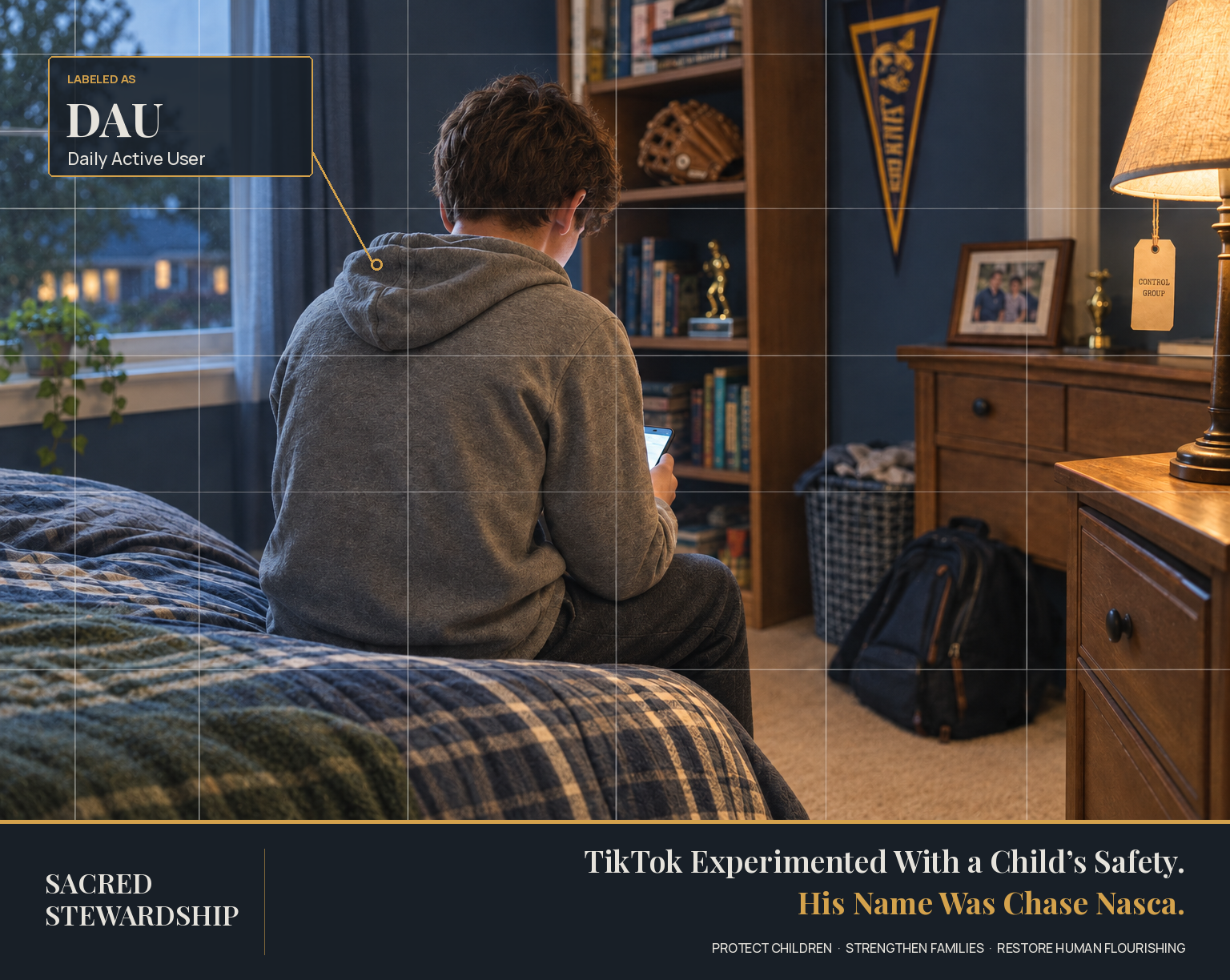
TikTok Withheld a Safety Guardrail From a 16-Year-Old. Then His Feed Filled With Suicide Content.
Bloomberg obtained a confidential TikTok document showing that the company withheld an algorithmic safety measure from millions of Americans while it studied the effect on engagement. Sixteen-year-old Chase Nasca was randomly placed in the experiment. Within a month, he was dead.
TikTok had developed a safety measure intended to stop its recommendation algorithm from trapping users in repetitive streams of potentially harmful content. But the company did not give that protection to everyone.
Instead, TikTok withheld the safer version of its algorithm from 10 percent of its U.S. users - roughly 15 million people at the time - creating a control group for an experiment designed, according to a confidential company document obtained by Bloomberg Businessweek investigative reporter Olivia Carville, to help determine whether the safety change would reduce the platform’s “stickiness.” One of the people randomly placed in that experiment was a 16-year-old boy from Long Island named Chase Nasca.
What happened next deserves national attention.
Chase was placed into the experiment on January 25, 2022. Because he was in the control group, TikTok’s filter-bubble prevention measures did not operate on his account. According to the company's own internal review obtained by Bloomberg, Chase became trapped in a filter bubble in which his account was repeatedly recommended content involving suicide, self-harm and depressive themes. Within a month, on February 18, 2022, Chase died by suicide.
The disturbing question raised by Carville's reporting is no longer simply whether harmful content existed on TikTok. It is why a technology company with millions of young users would withhold a safety intervention from a control group that included children while studying what that intervention might do to engagement.
What TikTok's Own Review Found
After Chase's death, TikTok investigated what its recommendation system had been showing him.
The company analyzed 7,563 videos served to Chase during the final two weeks of his life, according to reporting on TikTok's internal review. It found that 73 percent contained recurring themes that included mental-health struggles, suicide awareness and survivor testimonials, loneliness, relationship distress and sadness. Nearly another 10 percent violated TikTok's own policies prohibiting content that promotes or normalizes suicide or self-harm.
The company's internal assessment was striking. It concluded that Chase's account had fallen into a filter bubble characterized by repetitive recommendations involving suicide, self-harm and depressive subjects, particularly in the period preceding his death.
Not everything Chase did on TikTok involved those subjects. According to the internal review described by Bloomberg, many of his searches involved sports and comedy. He also searched for music associated with loneliness and hopelessness. TikTok's analysis concluded those searches likely contributed to its algorithm recommending more material with similar themes.
That distinction is important. Recommendation algorithms do not simply display material someone explicitly requests. They observe behavior and continually predict what to show next. A seemingly ordinary interaction can therefore become the beginning of a feedback loop in which increasingly similar material is repeatedly recommended.
TikTok knew enough about that phenomenon to develop a technological intervention intended to disrupt such filter bubbles.
Chase simply did not receive its protection.
“By Design”
Perhaps the most consequential finding in Carville's investigation is the explanation contained in TikTok's own internal document for why the filter-bubble intervention failed to protect Chase.
It wasn't a software malfunction.
According to the document, TikTok's filter-bubble protections did not operate on Chase's account “by design.”
He had been assigned to the experimental control group.
Bloomberg reports that TikTok had changed its algorithm beginning in 2021 to reduce the risk that users would become overwhelmed by repetitive harmful material. Rather than immediately deploying that safer system universally, however, TikTok retained the previous system for 10 percent of U.S. users so the company could measure the consequences of the change.
And the internal document reveals another extraordinary dimension of that decision.
According to Bloomberg's subsequent reporting, TikTok described the decision as requiring a balance between safety and its ability to measure effects on daily active users (DAU) and other core business metrics.
That is where this story moves beyond one algorithmic failure.
It becomes a question of corporate judgment.
TikTok had identified a risk serious enough to warrant developing a safety intervention. It nevertheless preserved an unprotected control group so it could measure the intervention's effects. That group included minors. And one of those minors was Chase Nasca.
Congress Had Already Raised Concerns
There is another piece of the chronology that makes the experiment particularly important.
According to Senators Richard Blumenthal of Connecticut and Marsha Blackburn of Tennessee, Congress had already raised concerns about TikTok's recommendation algorithm steering young users toward harmful material in October 2021 - months before Chase was randomly assigned to the experiment.
After Bloomberg revealed the experiment in August 2026, the senators sent a four-page letter to TikTok executives demanding answers. They characterized the reported experiment as “depraved” and asked why minors were permitted to participate in the control group. They also requested information about who inside TikTok knew about the experiment, when senior executives learned of it, and whether the company had conducted other experiments in which safety measures were disabled or delayed.
Carville reported the senators' response shortly afterward: they said the revelations raised questions about TikTok's repeated assurances to Congress, parents and the public that young people's safety took precedence over profit.
Those are precisely the questions that now require answers.
What Did TikTok Know - and Who Approved This?
TikTok's own document makes it impossible to dismiss Chase's experience merely as an unforeseeable tragedy involving harmful material somewhere on a vast social-media platform.
The company had identified the filter-bubble problem.
It had developed a safety response.
It had deliberately maintained a control group without that protection.
That control group included children.
And after Chase's death, TikTok's own investigators examined thousands of recommendations its system had delivered to him and concluded that his account had fallen into a repetitive filter bubble involving suicide, self-harm and depressive material.
That chronology demands scrutiny.
Who approved an experiment in which minors could be assigned to an algorithm without the newer safety intervention? What risk assessment was performed before children were included? Did TikTok specifically consider the possibility that a vulnerable young person could become trapped in precisely the type of harmful filter bubble the intervention was designed to disrupt? Who monitored the control group? Were there thresholds that would have automatically removed someone from the experiment if the recommendation system began repeatedly serving suicide or self-harm material?
And after TikTok analyzed those 7,563 videos, what happened internally?
Who received the findings? What decisions followed? What did TikTok tell regulators, lawmakers and parents?
These are not rhetorical questions. They are questions that should be answered with documents, testimony and evidence.
TikTok Says It Is Committed to User Safety
TikTok has said it is “deeply committed to the safety and well-being of users,” particularly teenagers. In a statement responding to Bloomberg's investigation, the company expressed sympathy for families who have experienced tragic losses and said it continues to invest substantially in Trust & Safety, including detection systems and teams tasked with proactively removing material that violates its rules.
Those investments matter.
But they do not answer the central question raised by TikTok's own internal document. Why was a safety intervention withheld from millions of people - including children - while the company measured its effect?
And why was a sixteen-year-old permitted to remain in that experiment as his recommendation feed descended into precisely the type of filter bubble the safety intervention was designed to prevent?
Chase Nasca Was Not an Engagement Metric
This is where the story becomes deeply personal for me as a mother and as the founder of Sacred Stewardship.
I have spent years studying the ways technology can shape children. But there is something about this case that crosses a line I cannot ignore.
A company may call someone a “user.” An analytics dashboard may call that person a daily active user. An experiment may place that person into a control group. An algorithm may reduce that person's behavior to signals, predictions and engagement probabilities.
But Chase Nasca was none of those things.
He was a child.
He was somebody's son.
He was sixteen years old.
There is a moral boundary here that Silicon Valley's language of optimization, experimentation and engagement too easily obscures. Human beings, especially children, cannot simply become variables in experiments designed to determine how safety changes affect the amount of time people spend on a platform.
Safety cannot be merely another metric to optimize against engagement.
Children are not test subjects. Their vulnerability is not a business variable. And their lives are not an acceptable cost of learning what makes an app more “sticky.”
What Happens Now
Parents should read Olivia Carville's investigation. Journalists should keep investigating the internal documents. Congress should pursue the questions Senators Blumenthal and Blackburn have raised. Regulators should determine what legal obligations apply. And TikTok should provide a complete accounting of the experiment: who authorized it, how minors were included, what risks were evaluated, what executives knew, and whether similar experiments involving safety interventions have occurred.
There is also a question for the companies spending billions of dollars advertising across social-media platforms.
Advertisers routinely demand measurement, brand safety and accountability for where their products appear. They should be equally willing to ask what platforms are doing to the human beings whose attention generates the advertising inventory they purchase.
Let's not underestimate the power and influence we have as parents.
We can ask what our children are actually being recommended rather than looking only at whom they follow. We can talk with them about how recommendation systems learn from their behavior. We can take suicide and self-harm material seriously. And we can decide that access to our children is not something a technology company is automatically entitled to have.
Today, ask your kid to show you what;s on their "For You Page" (FYP).
For Sacred Stewardship, that principle is simple:
Technology is a tool, not a teacher, parent, pastor, friend or source of identity. It is time to put technology back in its proper place - and put God, people and relationships back at the center of our familes, culture and country.
This story also requires institutional accountability. Parents cannot possibly supervise every algorithmic decision occurring invisibly behind a child's screen. A parent cannot activate a safety feature that a company has deliberately withheld. A mother cannot protect her child from an experiment she does not know exists.
That responsibility belongs to the people designing, approving and operating these systems.
Olivia Carville brought an extraordinary piece of evidence into public view. Senators are now demanding answers. The rest of us should make sure the questions do not disappear when the news cycle moves on.
Because behind the phrase “control group” were approximately 15 million actual people.
Behind the phrase “daily active users” were human lives.
And among them was a sixteen-year-old boy named Chase Nasca.
His life mattered more than TikTok's engagement metrics.
Every child's does.
Children are sacred. And no company should ever be permitted to forget the human being on the other side of its algorithm.
Read Olivia Carville’s Bloomberg investigation: https://news.bloomberglaw.com/health-law-and-business/internal-report-shows-tiktok-kept-safety-feature-from-millions
